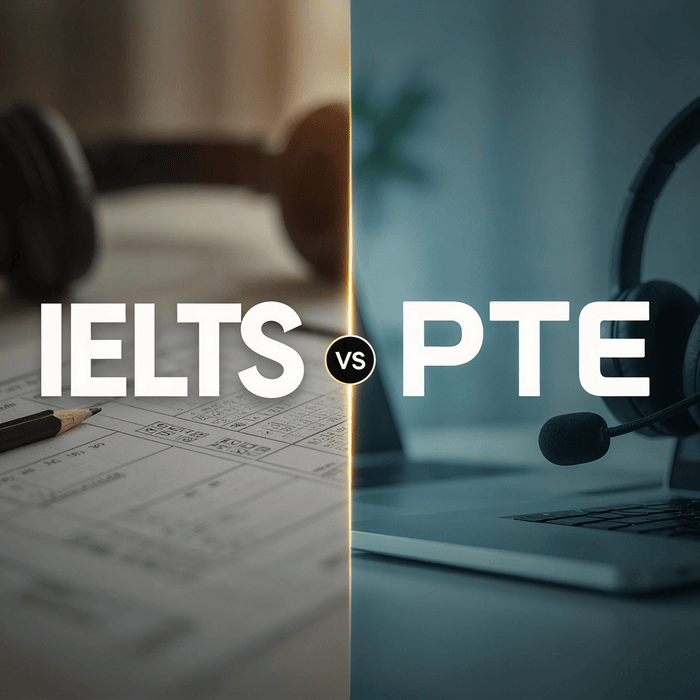
If you're planning to study abroad from Nepal in 2026, one of the very first decisions you'll face is this:
should you take IELTS or PTE? Both tests are accepted for university admission and student visas in Australia, the UK, Canada, and New Zealand — yet they differ in price, difficulty, exam format, and how fast you get your results. Choosing the wrong one can cost you weeks of preparation time and over NPR 30,000 in retake fees.
In this detailed comparison, we break down IELTS vs PTE for Nepali students — covering the latest 2026 exam fees in NPR, which test is genuinely easier for Nepali candidates, result delivery times, country-wise acceptance, score conversion, and the new 2026 PTE format changes that most students don't know about yet. By the end, you'll know exactly which test fits your profile.
IELTS vs PTE: The Quick Answer
In short:
PTE is slightly cheaper, delivers results faster, and suits students who are comfortable with computers. IELTS is accepted more universally — especially for the USA — and suits students who prefer face-to-face speaking and handwriting. If your target is Australia or the UK and you want quick results, PTE is a strong choice. If you're keeping the USA open or you're not confident typing on a keyboard, IELTS remains the safer, more widely recognized option. Now let's look at the details behind that answer.
What Is IELTS?
IELTS (International English Language Testing System) is the world's most widely accepted English proficiency test, jointly run by the British Council, IDP Education, and Cambridge Assessment English. It tests four skills — Listening, Reading, Writing, and Speaking — and scores you on a band scale of 1 to 9. In Nepal, you can take IELTS on paper or on computer through British Council or IDP centers in Kathmandu and other major cities. The Speaking test is a real, face-to-face interview with a human examiner.
What Is PTE?
PTE Academic (Pearson Test of English) is a fully computer-based test run by Pearson. All four skills are tested in a single sitting at a computer — you read on screen, type your written answers, and speak into a microphone. Your responses are scored by Pearson's AI system with human oversight, which is why PTE results arrive much faster than IELTS. Scores range from 10 to 90.
IELTS vs PTE Comparison Table for Nepali Students (2026)
| Factor |
IELTS |
PTE Academic |
| Exam Fee in Nepal (2026) |
NPR 33,000 (computer) / NPR 36,200 (paper) |
USD 220 (approx. NPR 32,000–33,000) |
| Test Format |
Paper or computer; Speaking with a human examiner |
Fully computer-based; speak into a microphone |
| Result Time |
2–5 days (computer) / around 13 days (paper) |
Usually within 48 hours |
| Scoring |
Band 1–9, scored by human examiners |
10–90, AI scoring with human oversight |
| Acceptance |
12,500+ institutions in 140+ countries, including all USA universities |
Widely accepted in Australia, UK, NZ, Canada; growing but narrower in the USA |
| Retake Option |
One Skill Retake available (computer-based) |
Full test retake only |
| Best For |
USA applicants; students who prefer human interaction |
Australia/UK applicants; fast results; confident typists |
Which Is Easier for Nepali Students: IELTS or PTE?
This is the question every student in Kathmandu asks, and the honest answer is:
it depends on your strengths, not on the test. Here's how the two compare for typical Nepali candidates:
Speaking: Many Nepali students feel nervous speaking face-to-face with a foreign examiner in IELTS — the pressure of a live interview affects their score. In PTE, you speak to a computer, which removes interview anxiety. However, PTE's microphone scoring demands clear, continuous speech: long pauses, low volume, or unclear pronunciation are penalized by the software. If you speak fluently but get nervous with people, PTE Speaking often feels easier. If your pronunciation is a weak point, the human IELTS examiner is usually more forgiving.
Writing: IELTS Writing is marked by human examiners and demands well-organized essays. PTE Writing is shorter and scored by AI, and strong vocabulary with correct grammar scores well. But note — you must type quickly. Students who rarely use a keyboard lose valuable time in PTE.
Reading and Listening: PTE's question types (fill-in-the-blanks, re-order paragraphs) reward practice with the format itself, and repeated mock tests improve scores quickly. IELTS Reading is more traditional and familiar to students coming from the NEB system.
The overall pattern we see with our students: candidates who practice with computers and take enough mock tests often reach their required PTE score faster, while students targeting Band 7+ writing quality or applying to the USA generally do better with structured
IELTS preparation classes in Kathmandu.
IELTS vs PTE Fees in Nepal 2026: Which Is Cheaper?
The price gap has narrowed in 2026. After Pearson increased the PTE list price to USD 220 in March 2026, PTE now costs roughly NPR 32,000–33,000 depending on the exchange rate at checkout — almost identical to computer-based IELTS at NPR 33,000. Paper-based IELTS remains the most expensive option at NPR 36,200.
The real cost difference comes from
retakes. If you miss your target in one section, computer-based IELTS offers the One Skill Retake — you re-sit only the section you failed. With PTE, you must pay for and retake the entire test. For students who are borderline in one skill (usually Writing), this makes IELTS the cheaper path over a full application cycle.
Result Speed: PTE Wins Clearly
PTE results usually arrive within 48 hours — sometimes the same day. Computer-based IELTS takes 2–5 days, and paper-based IELTS takes around 13 days. If your university deadline or visa appointment is close, PTE's speed can genuinely save your intake. This is one of the main reasons Australia-bound students in Nepal increasingly choose PTE.
Country Acceptance: Where Each Test Works
Australia: Both fully accepted for admission and Subclass 500 visas. PTE is extremely popular for
studying in Australia from Nepal.
UK: Both accepted, but check whether your course requires a UKVI-approved version (IELTS for UKVI or PTE Academic UKVI). Our counselors verify this for every
UK application before booking your test.
USA: This is the deciding factor for many. IELTS is accepted by virtually all US universities, while PTE acceptance is growing but still narrower. If the
USA is on your list, IELTS (or TOEFL — see our
TOEFL classes) is the safer choice.
Canada and New Zealand: Both tests are widely accepted for admission and visa purposes.
IELTS to PTE Score Conversion
| IELTS Band |
Approximate PTE Score |
| 6.0 |
50–57 |
| 6.5 |
58–64 |
| 7.0 |
65–72 |
| 7.5 |
73–78 |
Universities publish their own equivalencies, so always confirm the exact requirement on your offer letter. For detailed band requirements by country, read our guide on the
IELTS score required for the UK, Canada, Australia and New Zealand.
Important: PTE Changed in 2026 — Templates No Longer Work
Many students choose PTE because they've heard "you can memorize templates and score high." That advice is now outdated. In 2026, Pearson added two new question types —
Summarize Group Discussion (SGD) and
Respond to a Situation (RTS) — and both include human scoring oversight. Memorized template answers receive lower scores; natural, spontaneous responses are required. If you're preparing with old YouTube template tricks, your score will suffer. Proper guided practice with updated materials — like our
PTE classes in Kathmandu — is now essential.
So, Which Test Should You Choose?
Choose PTE if: your target country is Australia, the UK, Canada, or New Zealand; you need results urgently; you type comfortably; and speaking to a computer feels easier than a live interview.
Choose IELTS if: the USA is on your shortlist; you prefer handwriting or face-to-face speaking; you may need the One Skill Retake safety net; or your university specifically lists IELTS.
Still deciding your destination? Your test choice should follow your country choice, not the other way around. Our comparison of the
best country to study abroad from Nepal in 2026 will help you decide that first.
Prepare for IELTS or PTE in Kathmandu with The Pyramid Consultancy
At
The Pyramid Consultancy, Bagbazar (Kathmandu), we run structured
IELTS classes and
PTE classes with updated 2026 materials, regular mock tests, and one-on-one speaking practice. Not sure which test fits you? Take a free diagnostic mock test at our office opposite Padma Kanya Campus — we'll assess your profile and recommend the right test for your target country, completely free. Call
980-1986381 or
book your free counseling session today.
FAQs: IELTS vs PTE for Nepali Students
Is PTE easier than IELTS for Nepali students?
PTE feels easier for students who are comfortable with computers and nervous in live interviews. IELTS suits students with strong handwriting habits and clear pronunciation. Neither test is universally easier — mock test performance in both is the best way to decide.
Which is cheaper in Nepal: IELTS or PTE?
In 2026 the fees are nearly equal — PTE costs approximately NPR 32,000–33,000 (USD 220) and computer-based IELTS costs NPR 33,000. Paper-based IELTS is the most expensive at NPR 36,200.
Is PTE accepted in the USA for Nepali students?
PTE acceptance in the USA is growing but still limited compared to IELTS and TOEFL. If you're applying to US universities, IELTS or TOEFL is the safer choice.
How fast do PTE results come compared to IELTS?
PTE results typically arrive within 48 hours. Computer-based IELTS takes 2–5 days, while paper-based IELTS takes around 13 days.
Can I switch from IELTS to PTE preparation?
Yes — the core English skills transfer, but the question formats are very different, so you'll need at least 2–4 weeks of format-specific practice before booking your PTE exam.